
Commercial solar that pays for itself
Rooftop, ground-mount and carport solar for businesses, affordable housing and public buildings. We model what a system will save before you commit, design it around your property, and manage it through installation.
Drag to turn the panel. Flip it to see the bifacial back.
Panels that work from both sides
We specify high-efficiency modules such as the Q CELLS Q.PEAK DUO XL-G11S.3/BFG. It is bifacial: the front captures direct sunlight, and the glass back collects light reflected off a light roof or the ground below.
On ground-mount systems and carports, where light reaches the underside, that extra yield helps a system produce more from the same footprint.
The right system for your property
We look at your roof, land, parking and electrical service, then recommend the layout that produces the most value for the space you have.
Rooftop solar
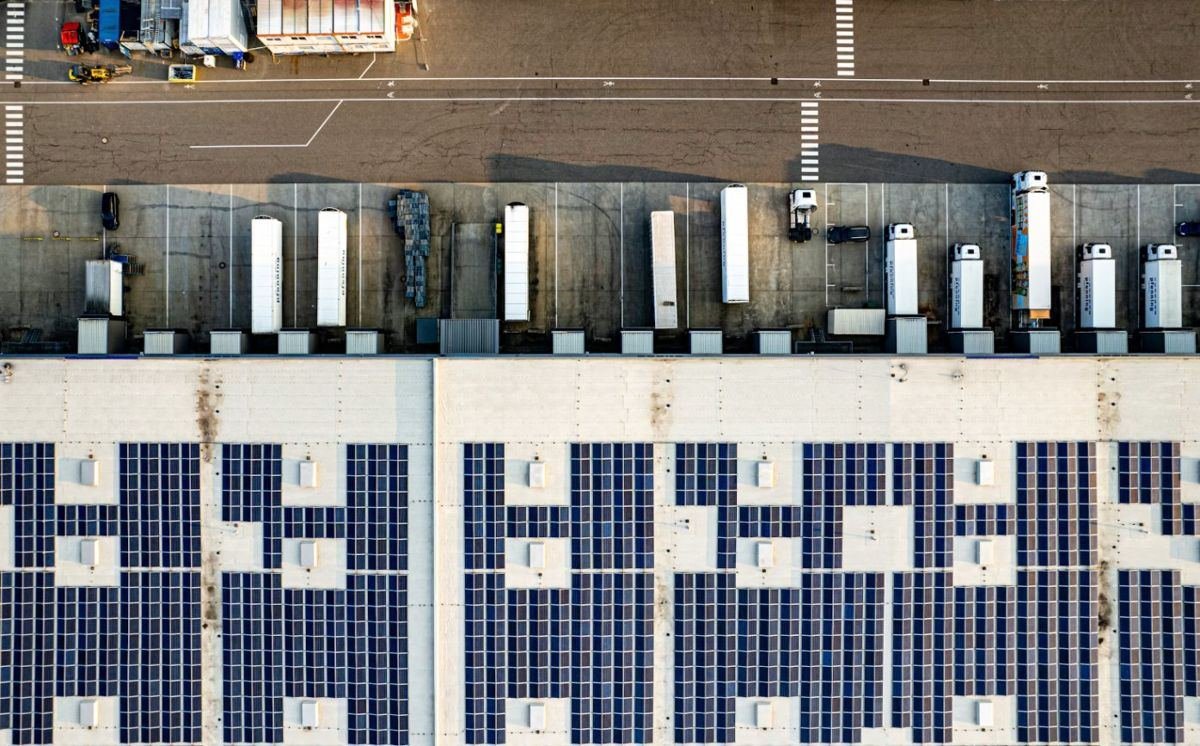
Uses space you already own. Best for warehouses, offices, retail and multifamily buildings with sound roofs and good sun exposure.
Ground-mount solar
For properties with open land. Easier to orient for maximum output and to expand later.
Solar carports
Turns parking lots into power plants and adds covered parking. Pairs naturally with EV charging.
What determines your savings
Every site is different, so we model yours rather than quote a rule of thumb. These are the factors that move the numbers most.
- Your electricity use and ratesHow much you buy, when you buy it, and what your utility charges per kWh and per kW.
- Available space and sunRoof condition and orientation, open land, shading and parking layout.
- Incentives and tariffsState and utility programs, and how the power you export is compensated.
- Ownership and financingBuying outright compared with financed structures, and what each means for cash flow.
- Pairing with storageA battery can cut demand charges and keep critical loads running in an outage.
From site review to switched on
Site review
We review your bills, roof or land, and electrical service to confirm solar is worth pursuing.
Model and design
We size the system and model its production and savings for your site.
Financing
We compare buying, loans, leases and power purchase agreements, with incentives, so you see the cash flow of each.
Approvals
We prepare the utility interconnection, incentive and permit applications and coordinate the stakeholders.
Installation
We coordinate installation, inspection and commissioning, then hand over a working system.
Built for properties with real energy costs or properties that just want to sell energy back to the grid
Affordable and multifamily housing
Lower common-area and building energy costs and capture incentives designed for housing providers.
Small to mid-size commercial
Warehouses, offices, retail, manufacturing and hospitality properties with steady daytime use.
Institutional and public sector
Municipal buildings, schools and campuses looking to cut costs and add resiliency.
Commercial solar in Connecticut
Most new commercial, municipal and nonprofit solar in Connecticut is compensated through the Non-Residential Renewable Energy Solutions (NRES) program. Key points:
- A 20-year tariff, with a choice of Buy-All (all output sold to the utility) or Netting (power used on site first, excess credited).
- Projects up to 200 kW AC are selected without competitive bidding; larger projects up to 5 MW bid in each program window.
- Separate options exist for school and municipal projects.
Adding a battery? Connecticut's battery storage demand response program, part of Energy Storage Solutions, pays commercial batteries $275 to $325 per kW per year for their first five years to discharge during peak grid events. It stacks with NRES. How it works →
We confirm which option and category fit your site and prepare the application. Details: Eversource NRES program.
Program details as of November 2026. Programs change each year; we confirm current terms during your site review.
Commercial solar questions
How long does a commercial solar project take?
It depends mostly on system size, permitting and the utility's interconnection review, which is often the longest step. We give you a project schedule after the site review.
Do I need a new roof first?
If your roof will need replacing within the life of the system, it is usually cheaper to replace it first. We assess roof condition during the site review and tell you plainly.
Can solar keep my building running in an outage?
Solar alone shuts off during a grid outage for safety. Adding battery storage lets critical loads keep running.
What happens to power I don't use?
It is exported to the grid and compensated under your utility's program. How it is valued depends on the program and option you choose, which we model for you.
Can I use my property to sell energy?
Yes. With a Buy-All arrangement, the solar system sells all of the power it produces to the utility at a fixed rate for the length of the contract, instead of powering your building. It suits open land, large roofs and parking lots where there is little on-site use, or owners who simply want a steady income from their property. In Connecticut, Buy-All is one of the two options under the NRES program, with a 20-year term. We assess whether your site qualifies and model what it could earn.
Related
Find out what solar would save you
Send us a recent utility bill and your address. We'll tell you whether solar is worth pursuing and what it could return.